


Before We Start
If you’re enjoying Duchump and want to help keep it going, please consider subscribing. Here are a few of my latest posts:
The Idyllic Strangeness of Time: A reflection on creative burnout, process-driven menswear, and thoughtful conversations with Mark from Archie and the duo behind the LVMH Prize–nominated label Tíscar Espadas.
Why This Designer Is Creating Quite the Buzz In Menswear: Before diving into our next PFW recap, let’s take an in-depth look at this Swedish designer’s philosophy, and why buyers and critics see the brand as one to watch.
I Think, Therefore I Tastemake: My thoughts on tastemaking, influence, and intention in modern content — exploring slow style, fatigue, and what’s to come
Basic? (How Japanese brands get labelled “boring” or “expensive,” and the disconnect between passion, content, and algorithm-driven taste)
I do not use affiliate links, and nor do I partner with brands for content. There’s already plenty of that on Substack. Everything I share here is my own genuine opinion — it isn’t bought, and it isn’t diluted to fit someone else’s agenda.
Your subscription helps keep this project alive and independent. My goal is to offer menswear coverage that feels grounded, honest, and human — without filters, or selling out.
We need more honesty in fashion. That’s what I’m here to deliver.
Thank you for being here.
Buck Mason
Writing this, and watching how it’s evolved since I first said something, has left me feeling a mix of things. Disappointment, confusion, anger. But also, at times, a bit of humour, reading through replies, DMs, and seeing how people have reacted to all of this.
For those who’ve been offline and actually living life — avoiding the dread of logging on and seeing nonsense across Instagram, Facebook, and everywhere else — Buck Mason released a campaign titled The Big Chino to celebrate their latest trousers. The kind of thing modern menswear guys drool over. You know, pants that Don Draper would wear before cheating on his wife.
The campaign visuals featured a jazz quintet playing in a dimly lit club, with sporadic close-ups of the cast wearing said chinos, and La La Land-esque shots of their musicians playing. It felt like I was watching a watered down, America-first, kids bop version of Mo Better Blues. Regardless of its concept — as someone that loves Jazz, I was interested, but there was one glaring issue I couldn’t ignore.
In the early 1900s, deep in the clubs and communities of New Orleans, a new genre emerged, pioneered by Black Americans, that would go on to change music history.
As Sound of Life explains, Louisiana’s Code Noir (a decree passed by French royals, meant to regulate relations between the enslaved and colonists) granted enslaved people limited time off on Sundays and certain holidays. During those rare moments of rest, Black communities gathered not just to socialize, but to create. Those gatherings became the birthplace of a historic, genre-defining sound shaped by lived experience, resilience, love, and musical influences from Africa, the Caribbean, and across North America.
Despite how much it’s evolved — from the innovations brought forth by Dizzy Gillespie and Charlie Parker, to the mind-bending, ever-expanding worlds of spiritual and abstract jazz shaped by Sun Ra and the Coltranes (both John Coltrane and Alice Coltrane) to hip-hop’s sampling the likes of Red Garland, Gary Bartz, and Ronnie Foster, all the way to today’s torchbearers like Makaya McCraven, Terrace Martin, and Kamasi Washington — it remains a genre that refuses to die, no matter how often people try to declare it otherwise.
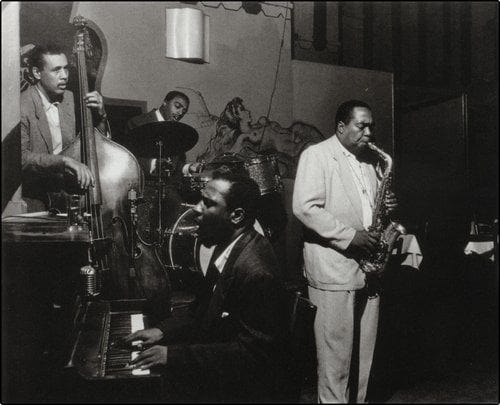
We have organizations today like Jazz Is Dead that, despite the name, exist purely to keep it alive; bringing together artists across generations and reintroducing the genre in ways that still feel fresh, strange, and necessary. I remember damn near foaming from the mouth when I found out they were hosting a show for Arthur Verocai — the Brazilian jazz legend and one of my favourite artists — three years ago in New York during my brief stint there. Easily one of the most memorable experiences of my life.
With that in mind, let’s fast forward to this today.
Buck Mason, an all-American brand marketed toward a very particular kind of American it seems like, released this campaign celebrating a musical and cultural era rooted in Black artistry and experience. Yet the glaring issue was the complete lack of representation.
This is cultural history, heritage, Black expression. And still, the brand chose to erase all of that, presenting an idealized, all-white version of a genre created and led by Black artists who were marginalized and demonized then and now. As I told someone who messaged me about it, and the comments I left on their post (which they deleted at first, only to add them back), there’s no way this felt accidental. It came across like a “Whites Only” club, just filmed in the modern day.
Unfortunately, this only adds to the reputation the brand already carries. Several people reached out to me describing discriminatory experiences while working there — Black team members allegedly treated differently than their white colleagues, told to present themselves a certain way, or pressured to change their hair to better fit the “Buck Mason look.” One subscriber shared that their brief stint with the brand felt like they were being asked to perform; tap-dancing for show.
While the brand tries to sell itself as tasteful, cultural, and American-focused, they give off What Kind of American Are You? from Civil War. Their presence feels like a brand romanticizing a version of Americana that’s deeply entangled with histories of segregation and redlining. What’s also disappointing is how some people reacted to my comments, framing them as “anti-white” rather than engaging with the substance of the critique, with one person saying “If you don’t like white people, find something else to look at.” The American education system continues to fail to instill basic comprehension skills and common sense, I guess, but I digress.


This was never about disliking any group of people (y’all white people are crazy, but I still love u) — it’s about calling out a brand profiting from Black cultural history while excluding the communities that built it.
This also isn’t new. Conversations around cultural erasure in America have only intensified in recent years, and it’s clear that progress in representation and acknowledgment remains uneven. So, it’s not that I’m trying to find something to be mad about, it’s about holding people accountable. Because this isn’t small, it’s part of a larger, ongoing issue — one that somehow feels like it’s accelerating in 2026, especially when you look at the current political and cultural climate in the US. There’s a growing boldness to the hate you see online. People aren’t even trying to hide it anymore, and that normalization is what makes it unsettling.
One subscriber put it in a way that stuck with me: it feels disorienting, almost surreal, watching things unravel in real time. It affects your mental health, especially when you’re being hit with jabs in-person as well. Last month, someone hit me with the “you people were our slaves” comment in the neighbourhood, here in Canada.
No, this isn’t some distant issue I’m observing from afar. It shows up here, too.
As for the US, the number of articles highlighting the erasure of Black culture in America has only grown since Trump first took office (five articles are linked there FYI), and it’s going to take years to get back to whatever form of progress was once seen prior to.
Anyway, to wrap this whole thing up.
Brands should continue to be held accountable for cases like this. This is one of many examples where cultural history is repackaged to cater to a certain audience, while the people who built it continue to be erased.
The lack of proper representation isn’t new, but that doesn’t make it any less exhausting. Constantly having to question whether you belong in a space, a place, or a community wears on you, and while we occasionally see glimpses of progress, it’s often short-lived — filtered, diluted, and ultimately revealed to be more performative than anything else.
In an industry that should be inclusive, brands like Buck Mason make it painfully clear which side of history they align with. At a certain point, we have to stop giving them our time altogether, and even if you strip this down to be purely a fashion critique, the clothes aren’t saying much anyway.
Honestly, all that felt missing from the campaign video was someone wearing the red hat — MAGA-fying a century of Black culture and history for mass consumption.
Note: As of March 19th, Buck Mason has neither addressed the criticism nor taken down the video.
Trump’s America is sadly all about cultural erasure and it’s so depressing seeing companies, which arguably have nothing to gain from doing so, align with that philosophy.
Now I’m kind of glad that the prohibitive shipping costs to Europe have prevented me from spending any money with Buck Mason so far. Thanks for bringing this to light!