


If you’re enjoying Duchump and want to help make coverage like this possible, please consider subscribing.
Your subscription keeps this project alive and independent. At a time when much of fashion media is driven by traffic, affiliate links, and advertising, I want Duchump to remain a place for thoughtful reporting and honest, at times chaotic, criticism.
Thank you for your support.
I was never a star student.
During my first four years of high school, I was usually at the basketball courts down the street instead of class. Some could say I was living my own version of One Tree Hill, except instead of being a star basketball player and Caucasian heartthrob, I was a light-skinned, curly-haired, lanky teenager wearing graphic tees that read, “I’m just like you, only smarter and better looking,” Limp Bizkit-enthusiast-sized jeans, and Phat Farm shoes (RIP).
On rainy days, I’d be listening to Bullet For My Valentine, Alexisonfire, John Coltrane, Lloyd, Bobby V, and Soundgarden, while spending countless hours on MapleStory. School wasn’t exactly my forte, so I never imagined fashion would somehow bring me back into a classroom years later.
This personal lore recap brings me to shoes. My biggest struggle with fashion is, and I’m definitely not alone here, footwear.
I can’t express the frustration of putting together a brilliant fit (when it hits, shit got me feeling like Bradley Cooper in Limitless), only to come crashing back down to earth when I realize I don’t have the right shoes to complete the look. It’s tragic. Makes you think, man. Makes you think.
Truthfully, I think this ongoing issue with footwear comes down to three things:
There are way, way too many options. I’ve lost track of how many pairs I’ve missed out on because I couldn’t decide between the colour, the leather, the sole, or whether I’d actually wear them enough to justify the purchase.
Shoes have become absurdly expensive over the past 5 years. How are you supposed to commit to a pair when it’s about to burn an $800–1,000 hole in your wallet? WWD recently reported footwear prices jumped another 5.2% this past May, marking the fifth increase in six months, and the most significant jump in four years. While that’s largely referring to sneakers, you can see the same thing happening throughout contemporary menswear.
(For my Our Legacy friends, remember when Camions were around $560 CAD? They’re now creeping towards the $1,000 mark.)Lastly, and probably my biggest gripe, footwear feels stagnant. Brands seem more interested in replicating one another than actually pushing things forward. Not feeling Paraboots? That’s all good, you’ve got Klemans, Yuketen, Solovair, or even Instagram brands like Collegium. Even fast fashion companies have their own versions now. Everyone’s making the same Michael-esque shoes, and if I’m being honest, it’s become quite boring.
Unsurprisingly, one of the bigger conversations throughout Paris Fashion Week was footwear, or more specifically, where to find good footwear. We’re starved for something refreshing, exciting. Or, if you’re like me, something that sits somewhere between wearable and weird enough to have elderly people walking past wondering whether you’re real, or a figment of their imagination.
(Sorry my shoes are hard as fuck, gramps. You hate me ‘cause you ain’t me.)
If I’m expected to spend so much on a pair of shoes, then they better tick off a few boxes like comfortability, design, quality, etc. I’d say practicality, but I’m 31 years old and I still don’t own a raincoat while living in the Pacific Northwest. It’s safe to say practicality isn’t a huge factor here.
Which brings me to Sine & Cosine.
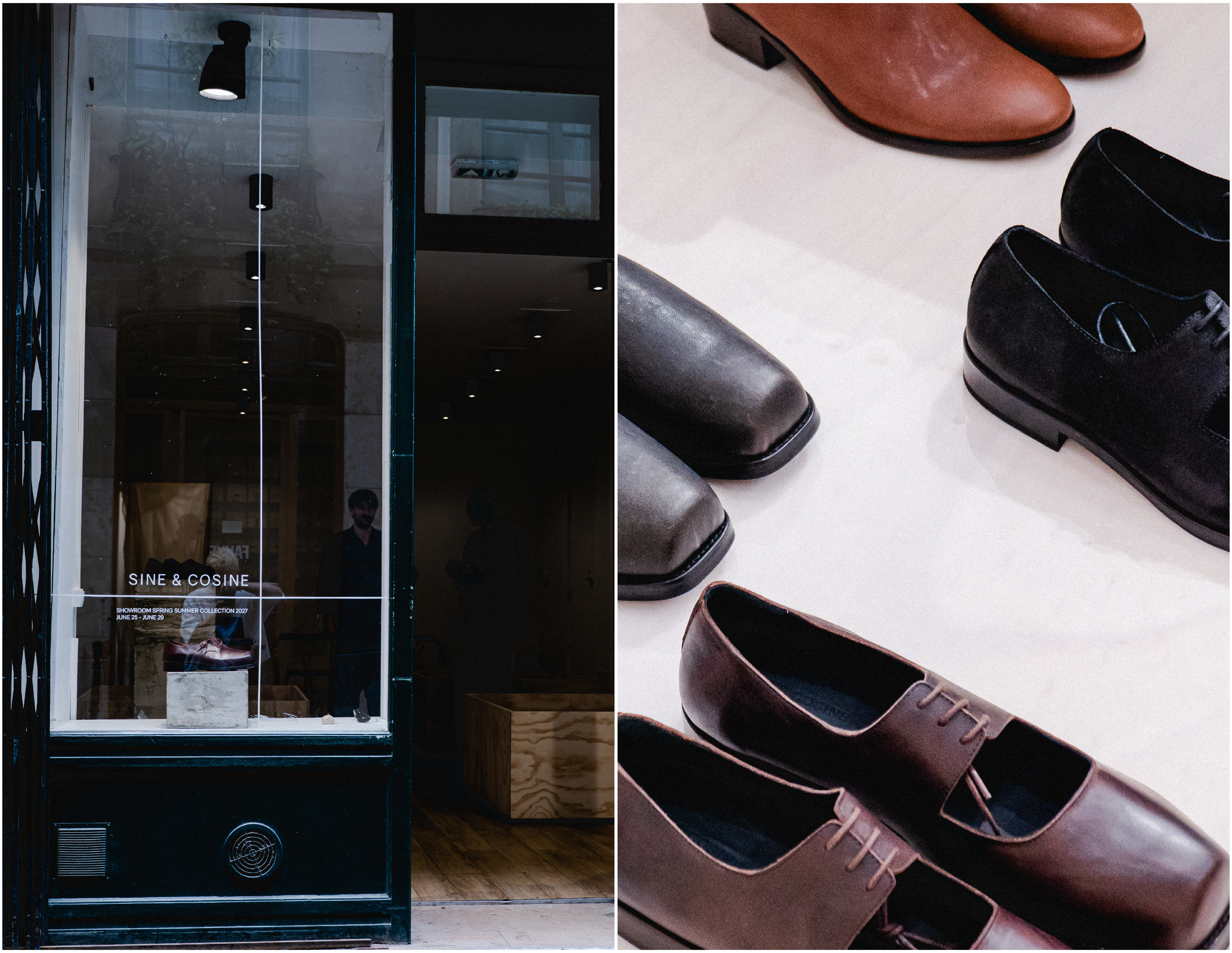
Founded by Felix Koopmans and Robert Pans, the Dutch-based brand has managed to do something that's surprisingly difficult today: make familiar footwear feel exciting again and their collections are entirely unisex. They've taken what could've been an ordinary shoe and turned it into something entirely their own. Naturally, this left me wondering how two people making actual fun, yet sleek, footwear landed on a name straight out of a Grade 10 math class.
“Robert and Felix both have a background in mathematics: Robert holds a master’s degree in econometrics, and Felix in stochastics,” Thomas Hibbert, their Head of Communication, tells me. “As neither had any formal education in fashion, they found a way to apply their academic knowledge to the design process. Hence, the brand was named after a cornerstone of mathematics.”
It’s an origin story that sounds a little strange at first, but after viewing their collection, it weirdly makes perfect sense. There’s something reassuring about knowing Felix and Robert don’t come from traditional fashion backgrounds. The fashion industry has a funny way of making you think you need the right education, the right internship, or the right connections before you’re allowed to contribute. Instead, they took what they knew best, applied it to footwear, and ended up launching one of the more exciting brands in fashion right now.
So, where do you even begin building a footwear brand like this?
“It started with the wooden clog, a piece of Dutch heritage that had become a tourist novelty,” Thomas tells me.
If you’ve been following Duchump recently, you’ll have noticed we’ve had a bit of a Dutch streak going, so it was fun seeing that thread continue. Robert and Felix wanted to reinterpret the clog through a contemporary lens, rather than leaving it as little more than a classic souvenir you bring to your parents. “That was the inception of our first design, The Hannes Clog. The process of bringing that design to life is what ultimately led to the founding of Sine & Cosine as a brand.”
Speaking of heritage, the brand had brought on a historian to work with the team. “Thomas joined the brand shortly after its launch,” Felix tells me, “It wasn’t a deliberate choice to bring someone with his background onto the team, our paths crossed through a mutual friend. Nevertheless, Thomas’ background in history grounded our concepts, pushing the design process forward.”
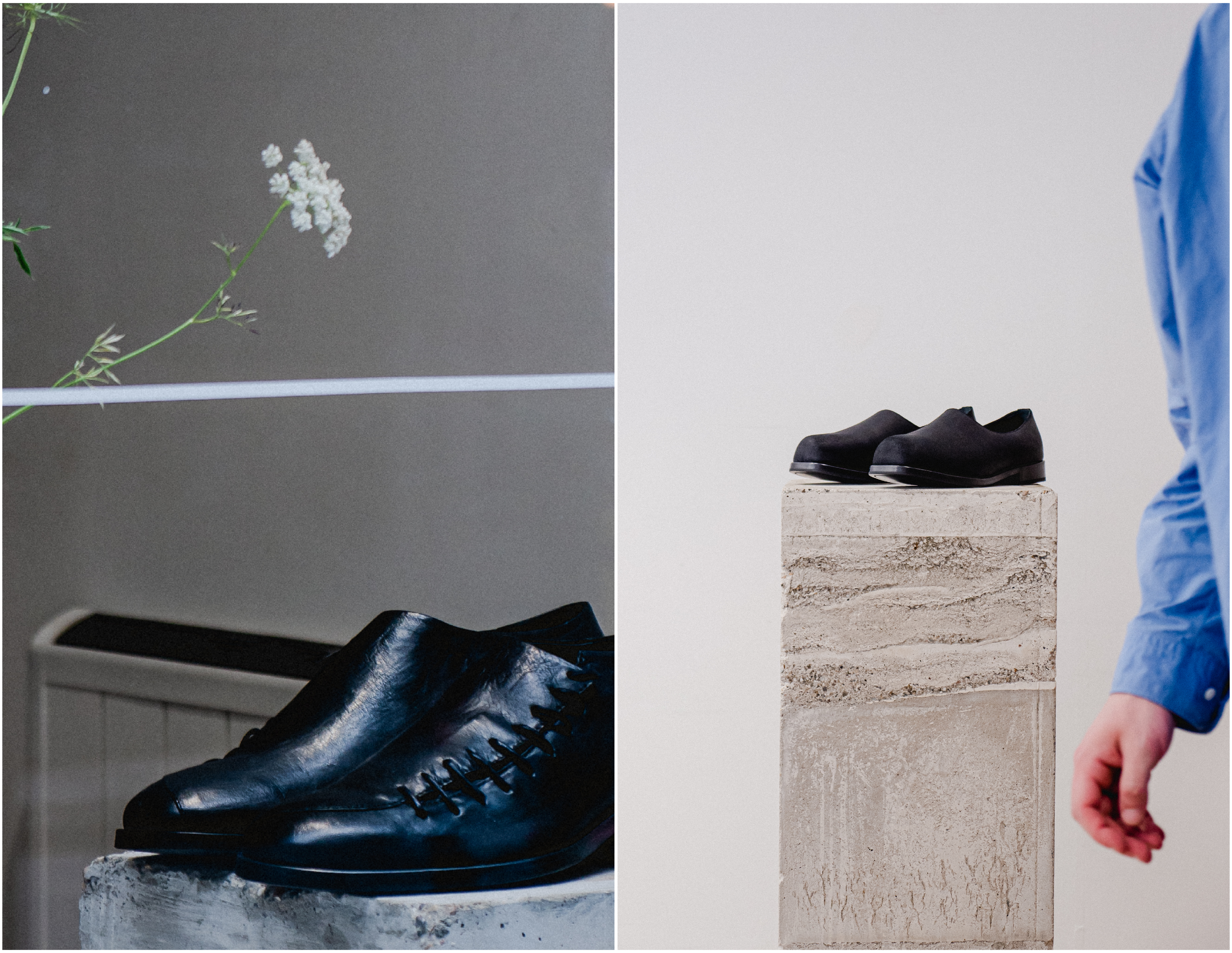
Their Theresia Derby is an example of this new, natural integration within the team, as the shoe feels historical, or as they say on their website, “draws inspiration from bygone centuries.” It looks like a relic, something lost in time only to be found and refurbished into something new. The cut-out opening makes almost any look more fun, especially paired with a good pair of socks.
It’s this blending of whimsy and stoicism that intrigues me, incorporating darker leathers into otherwise fun silhouettes. “There’s a methodology inherent in academia that we apply to our designs,” shares Felix. “For example, in mathematics, a problem must be distilled to its core components to be understood and solved,” he adds, “we apply that same methodology when designing. A historical reference is abstracted, disregarding any unnecessary details. With only the core components remaining, we form that into a minimalist contemporary design.”
Hearing Felix speak, my own trauma from failed math classes started creeping back in. My attention span could never survive a full lesson, though one teacher did figure out that the quickest way to get through to me was through music. We’d spend half the class talking about whatever I was listening to at the time before he’d throw on tracks like The Flaming Lips’ “I Wanna Get High, But I Don’t Want Brain Damage” and somehow convince me to pay attention for the next twenty minutes.
Song sucks, by the way.
To the average consumer, mathematics and fashion seem like polar opposites, but the more you think about it, the more you realize they’re actually quite intertwined. The precision in measurements, pattern-cutting, sizing, it’s all connected. “The intersection of those two worlds in a practical sense doesn’t largely influence our creative process,” shares Thomas.
“Of course, it helps a lot with the examples you mentioned. We focus more on mathematics as a theoretical and conceptual principle that drives our designs. For this season, the collection was inspired by topology—spatial characteristics of forms and how they hold their fundamental properties even as they change and shift. A theory like that, when you think about it, logically translates to footwear. It’s through those intersections that our approach is shaped.”
This perspective feels refreshing. It's not every day you hear a designer reference topology instead of nostalgia. Most brands today will find inspiration behind things that, in my opinion, feel more like a fabricated story for the sake of having a story. Things like “oh, I saw people at a cafe and felt inspired by the social aspects of life,” or the colours someone wore at Target, or “I listened to Creed and was touched by Scott Stapp’s lyricism.”
The last two have probably never been a source of inspiration for, well, anything. If you’ve heard otherwise, please let me know as I would love to interview whoever that is.
Whether or not topology means anything to you is almost beside the point. What stuck with me was seeing two people take the language they understood best and use it to solve a problem they felt footwear wasn’t solving. That’s a far more interesting starting point than chasing trends, and maybe that’s why Sine & Cosine’s work feels so different in the first place.
Brief pause.
You know what's funny?
Mathematics has always felt completely foreign to me, yet here I am discussing it with people who’ve mastered it. If anything, this conversation reminded me that the best ideas rarely come from the places you’d expect. While Felix and Robert’s approach to design immediately stood out, I was just as curious how that same mindset had shaped the brand.
“In your experience, can you touch on the progression of growing a smaller brand? Were there any significant hurdles or challenges along the way?” I ask.
“The most important challenge to overcome was finding a way to position ourselves to be patient with the brand,” Thomas shares.
“Finances are always an issue, cash flow problems with production, for example, so you’re inclined to jump at every opportunity and focus on short-term goals instead of long-term ones. We’re still very much at the beginning of our brand, but being patient has built a strong foundation we can expand upon.” We’ll often see small brands do too much, too quickly, but Sine & Cosines opts for the opposite, leading to their organic growth. “Figuring out how to achieve that position will differ from person to person and from brand to brand, but doing so is of great significance. Slow, sustainable growth will always trump quick cash and fast-paced expansion.”
With this in mind, this is the second Dutch-based brand I’ve interviewed recently, which makes me want to pull this thread further to see what else is cooking in places like Amsterdam. “It’s [Amsterdam] a creatively rich place that has a lot to offer for such a small city,” Thomas says. “Right now, there is definitely something brewing within fashion specifically. There has been a strong momentum for Dutch brands over the past few years, earning the city, and the Netherlands, more international recognition.”
And we’ve seen this with brands like De Dam Foundation slowly, but surely, stirring up buzz throughout menswear writers on Substack, and recently in the debut issue of In The Practice by Sven Minnis. “This momentum has also led to Amsterdam being a perfect incubator for smaller brands–in which we found ourselves. There’s no elbowing yourself to the top, everyone is keen to help each other in the capacity that they can. It’s an exciting development that will hopefully continue to further grow and blossom into the future.”
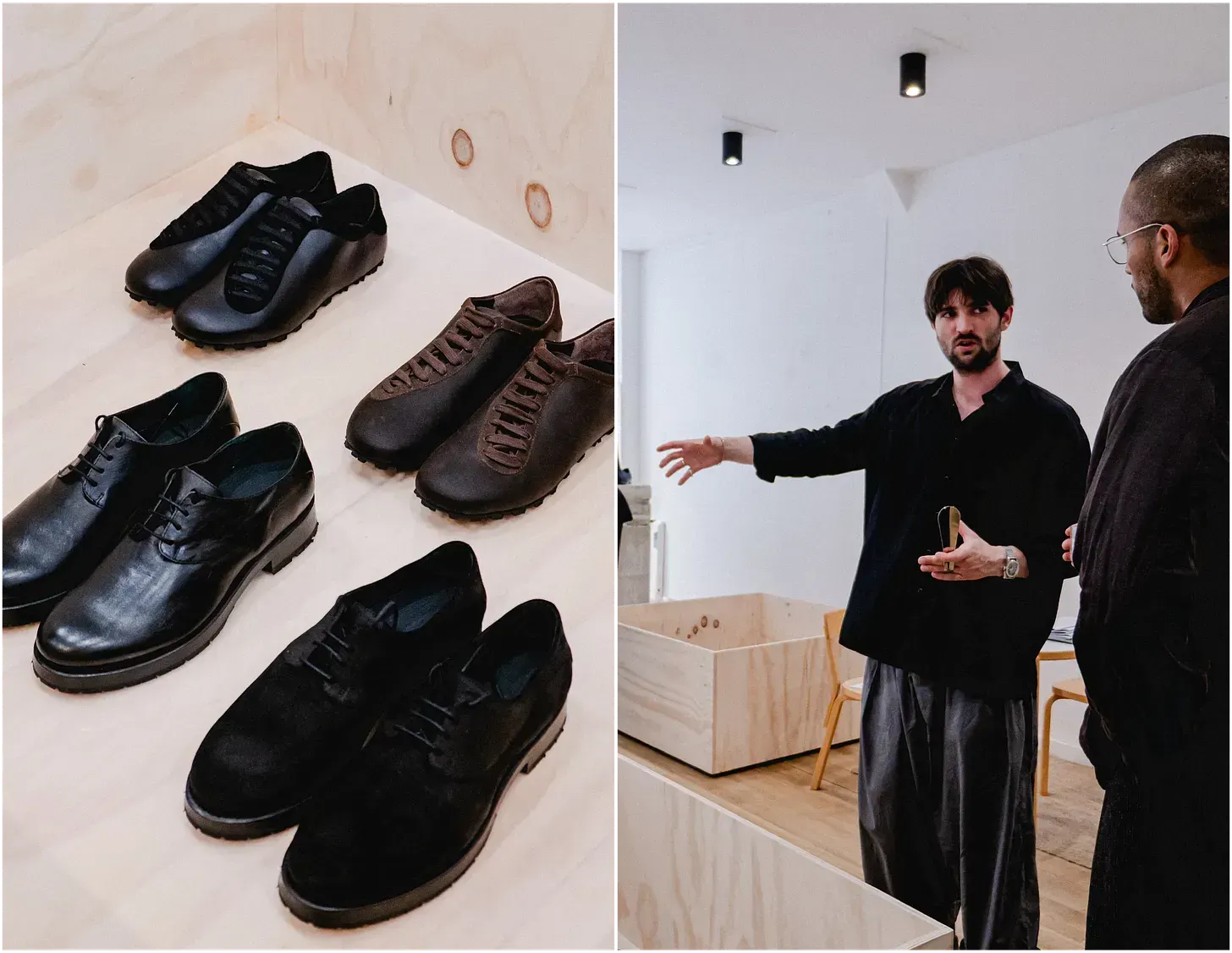
With this, it leads to my final question of the interview.
In your opinion, what’s the best way for a brand to survive, and actually thrive, in today’s landscape?
In a world where almost anyone can start a brand, and anyone with enough money can accelerate it, I was curious what surviving as a smaller operation actually looks like today. “Become recognizable through consistency in all your output and find a business strategy that will allow you to grow your brand steadily and sustainably.” The latter feels almost lost in today’s culture, as the number of people I’ve seen strive for greatness quickly without taking the time to settle, grind, get better, is disappointing, especially when you see potential there.
“This will help you to build a strong foundation without watering down your ideas.”
Right now, there’s nothing more precious than an innovative, creative mind. Your ideas, your concepts, your interests, it’s all so precious. We need more brands like Sine & Cosine. Their perspectives, their inspiration, the way they design and work, it’s refreshing to see and discuss.
This conversation left a funny feeling in my stomach, which sounds ridiculous considering we’ve spent the last few thousand words talking about shoes. But I don’t think this conversation was ever really about shoes. It was about curiousity, if that makes any sense.
I wasn’t a good student growing up, yet somehow fashion brought me back into classrooms I never expected to be sitting in, speaking to people I never thought I’d be chatting with, to discuss things such as mathematics, history, social justice, science, and so on. This time, I didn’t have the urge to skip class, or come up with an excuse to stay home for the day. Like my final year in high school, I found a way to connect to subjects I’ve always found terrifying, but in a way that’s comforting, and now with a curious mindset.
Maybe that’s what stayed with me most.
The best ideas rarely come from the places you’d expect. Sometimes they come from mathematicians making shoes, sometimes they come from historians helping shape them. All I know is I left the conversation feeling more curious than when I walked into it, and right now, that feels like one of the most valuable things fashion can offer.
I just hope I never lose this feeling.
Credits:
Words by Chris Maradiaga
Photography by Mackai Sharp